
2026 Bank On WA Forum Agenda
Plan Ahead!
Take a look through the agenda and start making plans about the sessions that will have the biggest impact in your work!
Day 1
| Time | Session | Location |
|---|---|---|
| 8:30AM | Registration & Check-In | Cherry Park Lobby |
| 9:00AM | Welcome & Intention Setting | Milgard Assembly |
| 9:15AM | Opening Plenary Jim Cooper, United Ways of the Pacific Northwest Adam Stein & Sabrina Smith, Columbia Bank Senator T'wina Nobles - Before exploring the barriers our communities face and the bridges we are building to overcome those barriers, we must first ground ourselves in a common framework for the learning and conversations at this event. This session will be a series of vignettes, examples of why collaboration is an effective resource against exclusion in three settings: Community, Financial Institutions, and Pubic Policy. | Milgard Assembly |
| 10:30AM | Break & Exhibitors | Columbia Bank Lobby, Milgard Assembly, & Kopp Gallery |
| 10:45AM | Simultaneous Sessions | Milgard Assembly Additional Rooms TBD |
D: Banking Obstacles and Solutions for Immigrant Communities Angelíca Yanten Winter, Guía Education & Consulting Hollyanna Volpat Steiner, Peninsula Credit Union, Scott Bossom, WaFd Immigrants face a variety of challenges when they seek banking services. As a result, many undocumented individuals save their money at home, putting their savings at risk. The presentation will outline these challenges, explain their root causes, and suggest solutions for each. | ||
E: From Application to Outcome: Reducing Fallout in the Homeownership Journey Jasmyn Jefferson, Windemere Gregory Davis, Black Home Initiative The Black Home Initiative (BHI) and its Leadership Council are examining a critical challenge in the homeownership ecosystem: the “fallout rate,” or the percentage of prospective homebuyers who begin the process but do not successfully complete it. Data from BHI’s service area shows that approximately 600 Black households per year exit the homeownership process, with fallout rates reaching as high as 34%, highlighting persistent gaps across financial systems, housing markets, and support services. This session is designed not only to present data, but to actively engage lenders, loan officers, and housing professionals who directly influence homeownership outcomes. Through facilitated discussion, participants will share frontline insights to help uncover root causes, particularly around withdrawals and other less visible drivers of fallout, and contribute to identifying practical strategies that can improve outcomes across the homeownership pipeline. | ||
F: Build a Bridge in Banking & Resource Deserts Molly Morris, Rural Resources Andrea Alexander, NW Native ABC This facilitated discussion will bring together ideas and connections for communities with limited access to resources. Both physical distance to available resources and inequitable barriers prevent people from walking their path to financial security.
| Milgard Assembly | |
| 11:45AM | Break & Exhibitors | Columbia Bank Lobby, Milgard Assembly, & Kopp Gallery |
| 12:00PM | Simultaneous Sessions | Milgard Assembly Additional Rooms TBD |
G: Affordable Health Care for all Washingtonians and Financial Health Lee Che Leong, Northwest Health Law Advocates US immigration policy perpetuates systemic inequity and racist exclusion, a reality reflected in Washington where the vast majority of individuals without federal immigration status are people of color. Federal policies that largely deny many immigrants access to healthcare mean that many Washingtonians go without critical health care. Being undocumented is the strongest predictor of being uninsured in Washington. In 2019, nearly 1 out of every 4 uninsured adults in Washington lack coverage due to their immigration status. This year federal changes from H.R. 1 continues to strip health coverage access from many lawfully present Washingtonians including refugees and asylees. Washington is working to mitigate this harm through 2 programs: Thankfully WA also has programs available regardless of immigration status such as Charity Care at hospitals and Apple Health for Kids. You're invited to come learn more about current programs, health access options in WA regardless of immigration status, and what you can do to improve access.
| ||
H: Rewriting the Rules of Credit: Advancing Housing Stability Through Equity-Centered Underwriting Maria Sennett, Beneficial State Foundation Evelin Martinez, Washington Homeownership Resource Center David Puszczewicz, WSECU Stable housing is foundational to long-term financial health, yet traditional credit and underwriting models continue to reproduce racial and structural inequities. Built on historically exclusionary assumptions about "risk," these systems often disadvantage borrowers from communities that have been underserved or excluded from mainstream financial institutions, undermining both equity and housing stability. This session explores how lenders and partners are actively rewriting the rules of credit to expand access to safe, sustainable housing while maintaining safety and soundness. Drawing on lessons from the Underwriting for Racial Justice (URJ) program and applied training in Reimagining Homeownership Services with a Racial Justice Lens, presenters will examine how core underwriting frameworks, such as the Five C's of Credit, can be interrogated, adapted, and reimagined through an equity-centered lens. Participants will hear directly from Washington-based lenders who have operationalized these shifts, including concrete changes to mortgage product design, underwriting flexibility, and internal policies and change management practices. By pairing conceptual framing with real-world implementation, the session offers actionable strategies for moving from risk aversion to risk management, demonstrating how equity-forward underwriting can strengthen housing outcomes, expand market reach, and remain aligned with regulatory expectations. | ||
I: Build a Bridge in Immigrant & Refugee Communities Moderated by Mary Vargas, Tacoma Community House This interactive workshop provides practical tools to build bridges of trust and cross-cultural connection within immigrant and refugee communities. Participants will collaborate on actionable strategies to overcome integration barriers and strengthen local support networks. | Milgard Assembly | |
| 1:00PM | Lunch & Exhibitors | Columbia Bank Lobby, Milgard Assembly, & Kopp Gallery |
| 2:00PM | Simultaneous Sessions | Milgard Assembly Additional Rooms TBD |
J: Finding the Oasis in the Financial Deserts Lisa Smith, Washington State Microenterprise Association Participants will explore and discover the power they have to search and find the information they need to support their dreams. There are organizations that have been working together for years to break down barriers to opportunity. They have been inspired to change how things are done because they themselves were once in a place where they didn’t know the right person or weren’t living in the right location or didn't know what was out there. During this session, the presenters will share stories and ideas that will inspire, because over and over when we share information and opportunity, vital change happens for the good. This workshop shines a light on signposts and the pathways to these oases in the desert and then offers simple practical tools to access and use these resources. | ||
K: A Continuum Approach to Housing Stability and Wealth Building Emily Jameson, Self-Help Federal Credit Union Antonia Mende, OIC of WA For many households, housing is not just a need—it is one of the most powerful pathways to long-term financial stability and generational wealth. Yet for low-income, rural, and immigrant communities, the path to homeownership is often delayed or denied due to systemic barriers This session will explore a relationship-based, continuum of care model that supports members from financial instability to sustainable homeownership—and beyond. Rather than focusing solely on loan approval, we invest in long-term readiness, often working with members for two to | ||
L: Build a Bridge in Financial Health is Healthcare Moderated by Kitty Grasswell, YWCA This facilitated discussion will bring together ideas and connections for addressing the causal relationship between finances and health. This relationship is most often seen at the individual level of making medical choices based on cost and leads to larger implications on the overall financial health of our communities. Together, we will delve into the question: How do we fill the gaps between significant community needs and available resources? | ||
| 3:00PM | Coffee Break: Network & Exhibitors | Columbia Bank Lobby, Milgard Assembly, & Kopp Gallery |
| 3:30PM | Starting Financial Literacy Classes Utilizing FEN Karlina Packard, Orion Industries Cynthia Gomez, Express Credit Union Clinton Taylor, Your Money Matters Mentoring Daniel Abrego, WaFd When Orion Industries started building their financial education program, their staff were tasked with becoming financial experts on top of their existing tasks. Through a LISC grant and a partnership with FEN, Orion Industries was able to adapt existing resources and share the burden of the program through relationships, rather than starting from scratch. Now, Orion Industries hosts regular financial education cohorts at their Auburn and Mukilteo sites with partners like Your Money Matters Mentoring, WaFd Bank, and Express Credit Union. Orion Industries staff were able to build their own financial knowledge and confidence in money conversations with clients while being supported by subject matter experts to explore specific topics. | Milgard Assembly |
| 4:30PM | Music & Exhibitors |
Day 2
| Time | Session | Location |
|---|---|---|
| 8:00AM | Check-In, Breakfast, and Exhibitors | Cherry Park Lobby |
| 8:30AM | Welcome Day 2 | Milgard Assembly |
| 9:00AM | O: Relationships Are Not a Marketing Strategy: Reimagining Cross-Sector Partnerships for Washington's Financial Future Mandy Lee, Verity Credit Union Jennifer Quiroz, Financial Empowerment Network | Milgard Assembly |
| 10:00AM | P: So You Know Relationships Aren't Marketing — Now What? A Working Session on Building Intentional Partnerships Mandy Lee, Verity Credit Union | Milgard Assembly |
| 11:00AM | Coffee Break: Networking & Exhibitors | Columbia Bank Lobby, Milgard Assembly, & Kopp Gallery |
| 11:30AM | Simultaneous Sessions | Rooms TBD |
T: Building Pathways to Financial Inclusion Through ITIN Partnerships Ryan McFerran, United Way of King County Tasha Dalstra, United Way of King County Raquel Gomez, Seattle Credit Union ITIN filers including immigrants and refugees remain significantly underrepresented among users of free tax services outside of King County. Community organizations across Washington operate more than a hundred free tax assistance sites each filing season. In 2025, these sites collectively helped file more than 48,000 tax returns statewide. Within King County, United Way prepared 40% of all VITA/TCE returns in Washington last year, and more than 70% of all VITA/TCE returns filed for ITIN holders statewide. Strong partnerships with local financial institutions, like Seattle Credit Union, have made all the difference. This integrated service model helps reduce key barriers in the ITIN application process, which is often complex, time-consuming, and costly for many low-income households. Seattle Credit Union's broader impact strategy focuses on serving the most underserved communities across its footprint, with the goal of helping all Washingtonians build generational wealth and long-term financial stability, regardless of immigration status. This session will address barriers faced by ITIN filers and how partnerships help bridge them. | ||
U: Disability & Financial Health Ruth Daugherty, NW Access Fund People with disabilities are far less financially healthy than people who do not have disabilities. They have lower employment rates, lower incomes and less savings, and higher debt burdens and lower credit scores; they are also 3 times more likely to be unbanked. The reasons for these disparities are complex and far-reaching. Financial institutions and financial educators can work to address some of these problems by developing disability competency, understanding disability benefits and the restrictions that come with them, creating thoughtful products that address the needs of disabled people, and providing inclusive financial education. | ||
V: Build a Bridge in the Continuum of Housing Stability Moderated by Krosbie Carter, Propvisor Housing stability depends on more than housing alone. Many organizations play a role in whether people can find and keep a home, have choices about where and how they live, and build toward their financial goals - even when housing isn't the focus of their work. Together, we'll look beyond our traditional roles to see how our work shapes the housing journey, identify where people are left to navigate gaps between organizations and systems, and uncover new ways we can work together to strengthen housing and financial security. | ||
| 12:30PM | Lunch & Exhibitors | Columbia Bank Lobby, Milgard Assembly, & Kopp Gallery |
| 1:30PM | Simultaneous Sessions | Rooms TBD |
Q: Building Financial Safety and Inclusion for Survivors of Gender Based Violence Sabrina Hamm, FreeFrom Raven Aäe, Haliruna Consulting Helen Gibson, Express Credit Union Nuray Ozbay Bilir, Self Help Credit Union Through multiple surveys of more than 2,000 survivors across the nation, FreeFrom has learned from survivors about their experiences with financial institutions, their current financial needs, and how their financial accounts are impacted by economic abuse. This research confirmed the call to action: survivors need tailored services that address their unique needs. Otherwise, survivors may be locked out of financial services key to navigating daily life and In this session, attendees will learn both how gender-based violence and economic abuses can be perpetuated through financial services as well as actions they can implement to support survivors. Elizabeth Escobar (Express Credit Union) and Nuray Ozbay Bilir (Self-Help Credit Union) will provide guidance and examples of how the industry can respond to survivors’ needs. After this session, attendees will understand the role they can play in ending gender-based violence and supporting survivors’ long-term financial security. | ||
R: Housing Stability Through The Cooperative Model for BIPOC Communities Kaleb Hoeffgen, Northwest Cooperative Development Center Isaias Espinoza, Northwest Cooperative Development Center This presentation looks at how housing cooperatives and the broader cooperative economy can support housing stability and economic resilience for BIPOC and marginalized communities across Washington State. It draws on the work of the Northwest Cooperative Development Center (NWCDC), which has spent more than 30 years helping people create and sustain cooperatively owned housing and businesses. The focus is on how shared ownership models—especially Resident Owned Communities and worker co-ops—can keep housing affordable, prevent displacement, and give communities more control over their economic future. We’ll share practical examples from NWCDC’s work, including housing co-ops, business start-ups, and ownership conversions. These stories connect to a broader idea: that housing stability is the foundation for financial health. The session also looks at the realities facing immigrant and refugee communities, especially as policies shift, and how financial stress shows up in people’s physical and mental health. Rather than staying abstract, this part of the presentation is grounded in what’s actually working—and where the gaps still are. The final section steps back and looks at where the cooperative sector stands in Washington today, and what it will take to grow it. That includes addressing banking and resource deserts that leave many communities—especially rural and Tribal areas—without safe, affordable financial services. We’ll talk about how lenders, public agencies, and community partners can better support cooperative ownership, and what it would look like to build a stronger, more inclusive ecosystem around shared ownership and long-term stability. | ||
S: Financial Stress Is a Health Issue: How Practitioners Can Respond Without Doing It All Becky House, American Financial Solutions Abby McCutcheon, American Financial Solutions Susan Romei, Banner Bank Fernando Espina, Banner Bank Liz Seeley, Neighborhood House Financial challenges don’t stay confined to bank accounts; they show up in stress, health outcomes, workplace performance, and family stability. Practitioners across sectors are often the first to see these impacts, but many are unsure how far their role should extend. This session explores the connection between financial stress and health and offers practical guidance on how to respond without overextending. Attendees will learn how to identify when a client needs additional support, how to build effective referral pathways, and how cross-sector partnerships can improve outcomes without requiring any one organization to do it all. Grounded in real-world examples, this session emphasizes a key message: you don’t need to be the expert in everything – you need to know how to connect people to the right support. | ||
| 2:30PM | Coffee Break: Network & Exhibitors | Columbia Bank Lobby, Milgard Assembly, & Kopp Gallery |
| 2:50PM | W: Closing Plenary Megan Pirie, Washington State Department of Corrections Trisha Newport, Washington State Department of Corrections Darryl Riley, Up From Slavery Initiative | Milgard Assembly |
| 3:30PM | Music & Exhibitors' last call |
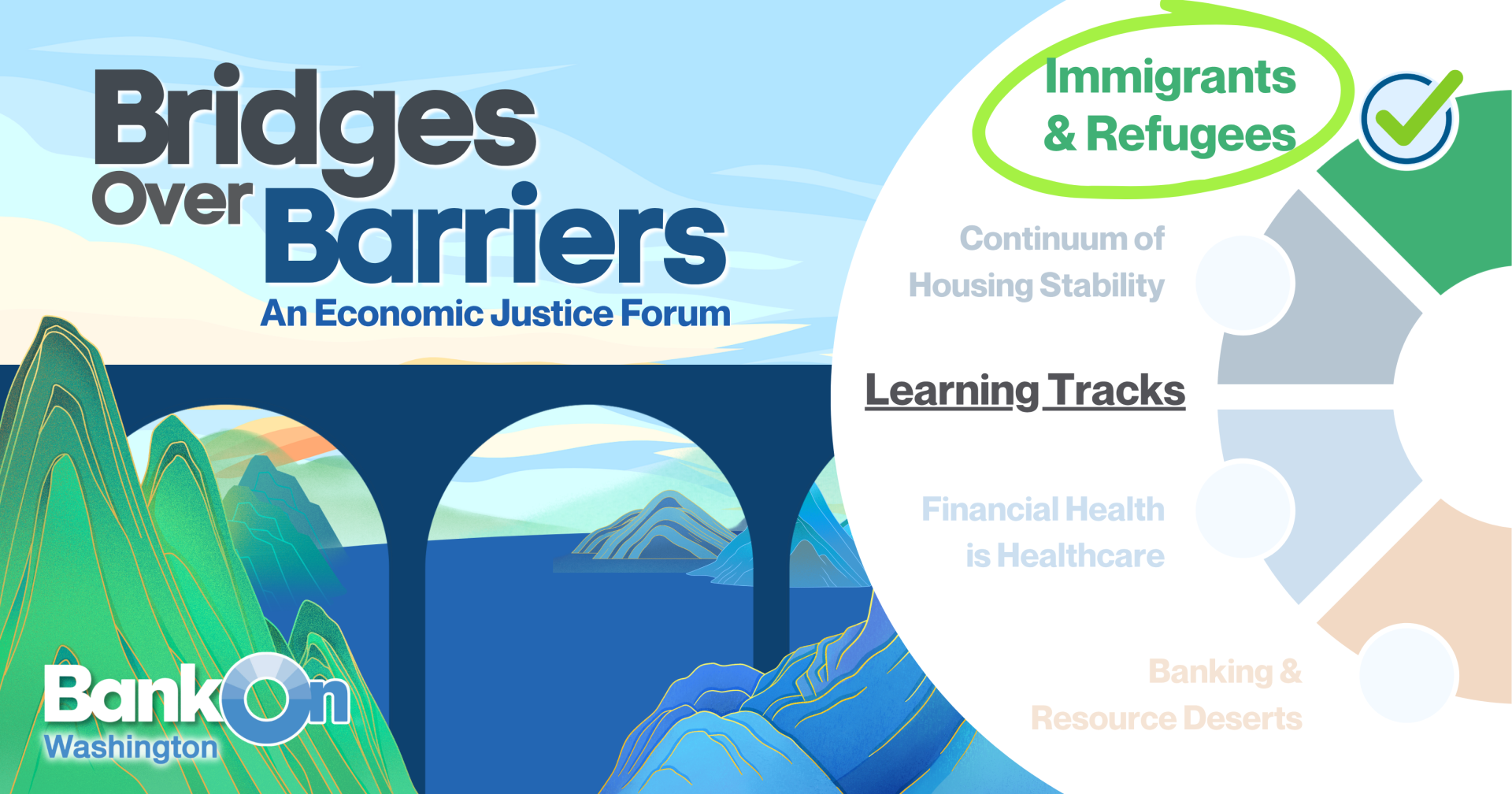
Day 1
Session D: Banking Obstacles and Solutions for Immigrant Communities
10:45-11:45 AM
Angelíca Yanten Winter, Guía Education & Consulting
Hollyanna Volpat Steiner, Peninsula Credit Union,
Scott Bossom, WaFd
Immigrants face a variety of challenges when they seek banking services. As a result, many undocumented individuals save their money at home, putting their savings at risk. The presentation will outline these challenges, explain their root causes, and suggest solutions for each.
Session G: Affordable Health Care for all Washingtonians and Financial Health
12:00-1:00 PM
Lee Che Leong, Northwest Health Law Advocates
US immigration policy perpetuates systemic inequity and racist exclusion, a reality reflected in Washington where the vast majority of individuals without federal immigration status are people of color. Federal policies that largely deny many immigrants access to healthcare mean that many Washingtonians go without critical health care. Being undocumented is the strongest predictor of being uninsured in Washington. In 2019, nearly 1 out of every 4 uninsured adults in Washington lack coverage due to their immigration status. This year federal changes from H.R. 1 continues to strip health coverage access from many lawfully present Washingtonians including refugees and asylees.
Washington is working to mitigate this harm through 2 programs:
1) expanding access to all Washingtonians to HealthPlanFinder, our state insurance marketplace with state subsidies for those up to 250% FPL, and
2) the Apple Health Expansion/Medicaid-like program for adults without access to federal subsidies or federal Medicaid up to 138% FPL
However, current funding for both programs is limited.
Thankfully WA also has programs available regardless of immigration status such as Charity Care at hospitals and Apple Health for Kids.
You're invited to come learn more about current programs, health access options in WA regardless of immigration status, and what you can do to improve access.
Catch this optional “Part 1” with Lee Che:
Upcoming Immigrant Health Changes, Challenges & Options Thursday August 6th, 2026
Workshop Recording | Presentation Slides | Federal Health Care Changes Hub - Northwest Health Law Advocates
Session I: Build a Bridge in Immigrant & Refugee Communities
12:00-1:00PM
Moderated by Mary Vargas, Tacoma Community House
This interactive workshop provides practical tools to build bridges of trust and cross-cultural connection within immigrant and refugee communities. Participants will collaborate on actionable strategies to overcome integration barriers and strengthen local support networks.
Session K:A Continuum Approach to Housing Stability and Wealth Building
2:00-3:00 PM
Emily Jameson, Self-Help Federal Credit Union
Antonia Mende, OIC of WA
For many households, housing is not just a need—it is one of the most powerful pathways to long-term financial stability and generational wealth. Yet for low-income, rural, and immigrant communities, the path to homeownership is often delayed or denied due to systemic barriers
such as limited credit history, insufficient savings, rising housing costs, and reliance on high-cost financial products.
This session will explore a relationship-based, continuum of care model that supports members from financial instability to sustainable homeownership—and beyond. Rather than focusing solely on loan approval, we invest in long-term readiness, often working with members for two to
three years prior to purchase to build credit, grow savings, and stabilize household finances through culturally competent, in-house financial coaching and leveraging relationships with external, mission-aligned agencies.
Day 2
Session T: Elevating Tax Benefits Through ITIN Partnerships
11:30 AM - 12:30 PM
Ryan McFerran, United Way of King County
Tasha Dalstra, United Way of King County
Raquel Gomez, Seattle Credit Union
ITIN filers including immigrants and refugees remain significantly underrepresented among users of free tax services outside of King County. Community organizations across Washington operate hundreds of free tax assistance sites each filing season. In 2025, these sites collectively helped file more than 48,000 tax returns statewide. Within King County, United Way prepared 40% of all VITA/TCE returns in Washington last year, and more than 70% of all VITA/TCE returns filed for ITIN holders statewide.
Strong partnerships with local financial institutions, like Seattle Credit Union, have made all the difference. This integrated service model helps reduce key barriers in the ITIN application process, which is often complex, time-consuming, and costly for many low-income households.
Seattle Credit Union's broader impact strategy focuses on serving the most underserved communities across its footprint, with the goal of helping all Washingtonians build generational wealth and long-term financial stability, regardless of immigration status.
This session will briefly address key data security considerations, including IRS data-sharing agreements and coordination with law enforcement agencies, to ensure that expanded service delivery models maintain strong protections for client privacy and trust.
Session R: Housing Stability Through The Cooperative Model for BIPOC Communities
1:30-2:30 PM
Kaleb Hoeffgen, Northwest Cooperative Development Center
Isaias Espinoza, Northwest Cooperative Development Center
This presentation looks at how housing cooperatives and the broader cooperative economy can support housing stability and economic resilience for BIPOC and marginalized communities across Washington State. It draws on the work of the Northwest Cooperative Development Center (NWCDC), which has spent more than 30 years helping people create and sustain cooperatively owned housing and businesses. The focus is on how shared ownership models—especially Resident Owned Communities and worker co-ops—can keep housing affordable, prevent displacement, and give communities more control over their economic future.
We’ll share practical examples from NWCDC’s work, including housing co-ops, business start-ups, and ownership conversions. These stories connect to a broader idea: that housing stability is the foundation for financial health. The session also looks at the realities facing immigrant and refugee communities, especially as policies shift, and how financial stress shows up in people’s physical and mental health. Rather than staying abstract, this part of the presentation is grounded in what’s actually working—and where the gaps still are.
The final section steps back and looks at where the cooperative sector stands in Washington today, and what it will take to grow it. That includes addressing banking and resource deserts that leave many communities—especially rural and Tribal areas—without safe, affordable financial services. We’ll talk about how lenders, public agencies, and community partners can better support cooperative ownership, and what it would look like to build a stronger, more inclusive ecosystem around shared ownership and long-term stability.
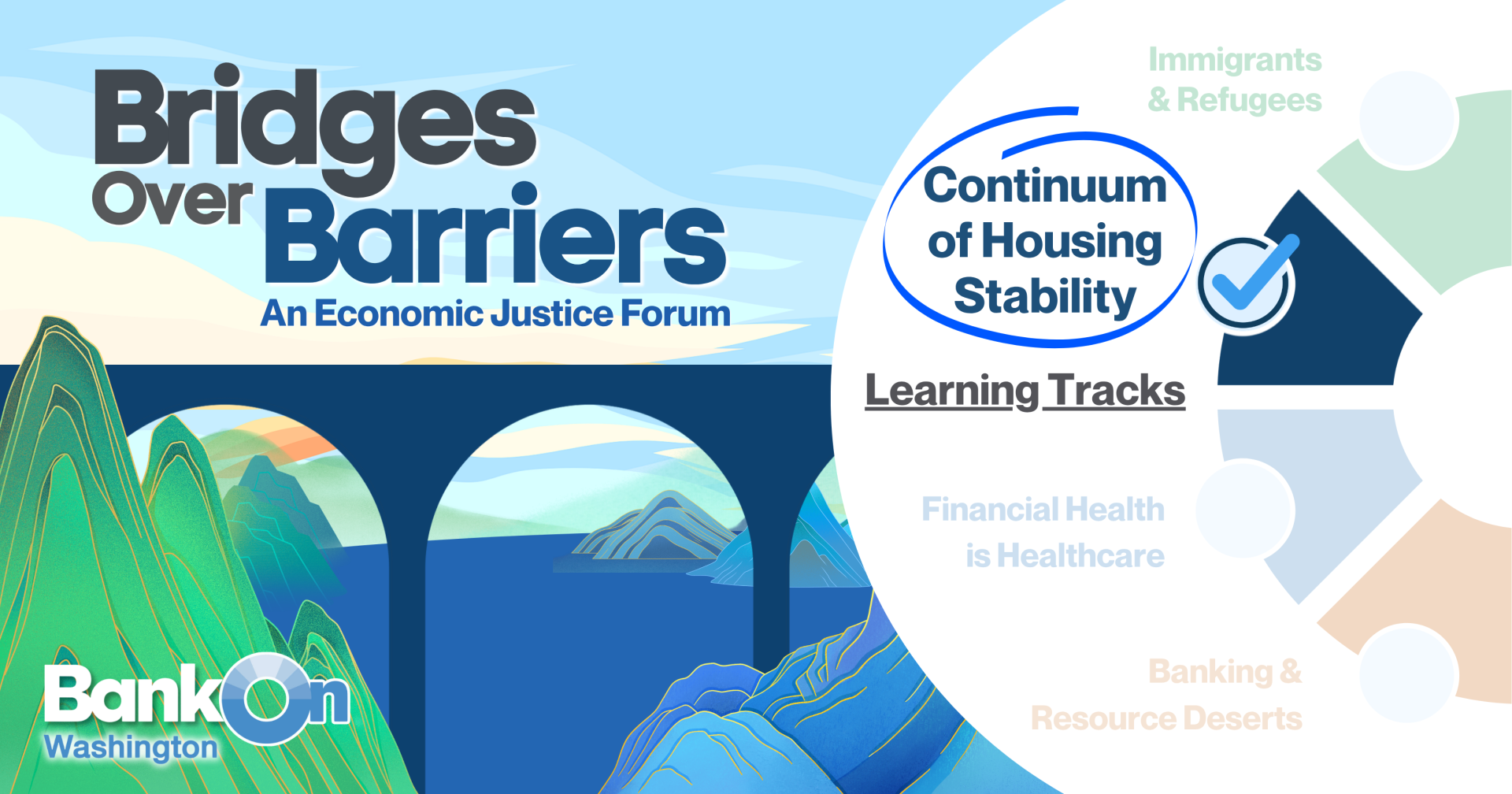
Day 1
Session E: From Application to Outcome: Reducing Fallout in the Homeownership Journey
10:45-11:45AM
Jasmyn Jefferson, Windemere
Gregory Davis, Black Home Initiative
The Black Home Initiative (BHI) and its Leadership Council are examining a critical challenge in the homeownership ecosystem: the “fallout rate,” or the percentage of prospective homebuyers who begin the process but do not successfully complete it. Data from BHI’s service area shows that approximately 600 Black households per year exit the homeownership process, with fallout rates reaching as high as 34%, highlighting persistent gaps across financial systems, housing markets, and support services.
This session is designed not only to present data, but to actively engage lenders, loan officers, and housing professionals who directly influence homeownership outcomes. Through facilitated discussion, participants will share frontline insights to help uncover root causes, particularly around withdrawals and other less visible drivers of fallout, and contribute to identifying practical strategies that can improve outcomes across the homeownership pipeline.
Session H: Rewriting the Rules of Credit: Advancing Housing Stability Through Equity-Centered Underwriting
12:00-1:00 PM
Maria Sennett, Beneficial State Foundation
Evelin Martinez, Washington Homeownership Resource Center
David Puszczewicz, WSECU
Stable housing is foundational to long-term financial health, yet traditional credit and underwriting models continue to reproduce racial and structural inequities. Built on historically exclusionary assumptions about "risk," these systems often disadvantage borrowers from communities that have been underserved or excluded from mainstream financial institutions, undermining both equity and housing stability.
This session explores how lenders and partners are actively rewriting the rules of credit to expand access to safe, sustainable housing while maintaining safety and soundness. Drawing on lessons from the Underwriting for Racial Justice (URJ) program and applied training in Reimagining Homeownership Services with a Racial Justice Lens, presenters will examine how core underwriting frameworks, such as the Five C's of Credit, can be interrogated, adapted, and reimagined through an equity-centered lens.
Participants will hear directly from Washington-based lenders who have operationalized these shifts, including concrete changes to mortgage product design, underwriting flexibility, and internal policies and change management practices. By pairing conceptual framing with real-world implementation, the session offers actionable strategies for moving from risk aversion to risk management, demonstrating how equity-forward underwriting can strengthen housing outcomes, expand market reach, and remain aligned with regulatory expectations.
Session K: A Continuum Approach to Housing Stability and Wealth Building
2:00-3:00 PM
Emily Jameson, Self-Help Federal Credit Union
Antonia Mende, OIC of WA
For many households, housing is not just a need—it is one of the most powerful pathways to long-term financial stability and generational wealth. Yet for low-income, rural, and immigrant communities, the path to homeownership is often delayed or denied due to systemic barriers
such as limited credit history, insufficient savings, rising housing costs, and reliance on high-cost financial products.
This session will explore a relationship-based, continuum of care model that supports members from financial instability to sustainable homeownership—and beyond. Rather than focusing solely on loan approval, we invest in long-term readiness, often working with members for two to
three years prior to purchase to build credit, grow savings, and stabilize household finances through culturally competent, in-house financial coaching and leveraging relationships with external, mission-aligned agencies.
Day 2
Session V: Build a Bridge in the Continuum of Housing Stability
11:30 AM - 12:30 PM
Moderated by Krosbie Carter, Propvisor
Housing stability depends on more than housing alone. Many organizations play a role in whether people can find and keep a home, have choices about where and how they live, and build toward their financial goals - even when housing isn't the focus of their work.
Together, we'll look beyond our traditional roles to see how our work shapes the housing journey, identify where people are left to navigate gaps between organizations and systems, and uncover new ways we can work together to strengthen housing and financial security.
Session R: Housing Stability Through The Cooperative Model for BIPOC Communities
1:30-2:30 PM
Kaleb Hoeffgen, Northwest Cooperative Development Center
Isaias Espinoza, Northwest Cooperative Development Center
This presentation looks at how housing cooperatives and the broader cooperative economy can support housing stability and economic resilience for BIPOC and marginalized communities across Washington State. It draws on the work of the Northwest Cooperative Development Center (NWCDC), which has spent more than 30 years helping people create and sustain cooperatively owned housing and businesses. The focus is on how shared ownership models—especially Resident Owned Communities and worker co-ops—can keep housing affordable, prevent displacement, and give communities more control over their economic future.
We’ll share practical examples from NWCDC’s work, including housing co-ops, business start-ups, and ownership conversions. These stories connect to a broader idea: that housing stability is the foundation for financial health. The session also looks at the realities facing immigrant and refugee communities, especially as policies shift, and how financial stress shows up in people’s physical and mental health. Rather than staying abstract, this part of the presentation is grounded in what’s actually working—and where the gaps still are.
The final section steps back and looks at where the cooperative sector stands in Washington today, and what it will take to grow it. That includes addressing banking and resource deserts that leave many communities—especially rural and Tribal areas—without safe, affordable financial services. We’ll talk about how lenders, public agencies, and community partners can better support cooperative ownership, and what it would look like to build a stronger, more inclusive ecosystem around shared ownership and long-term stability.
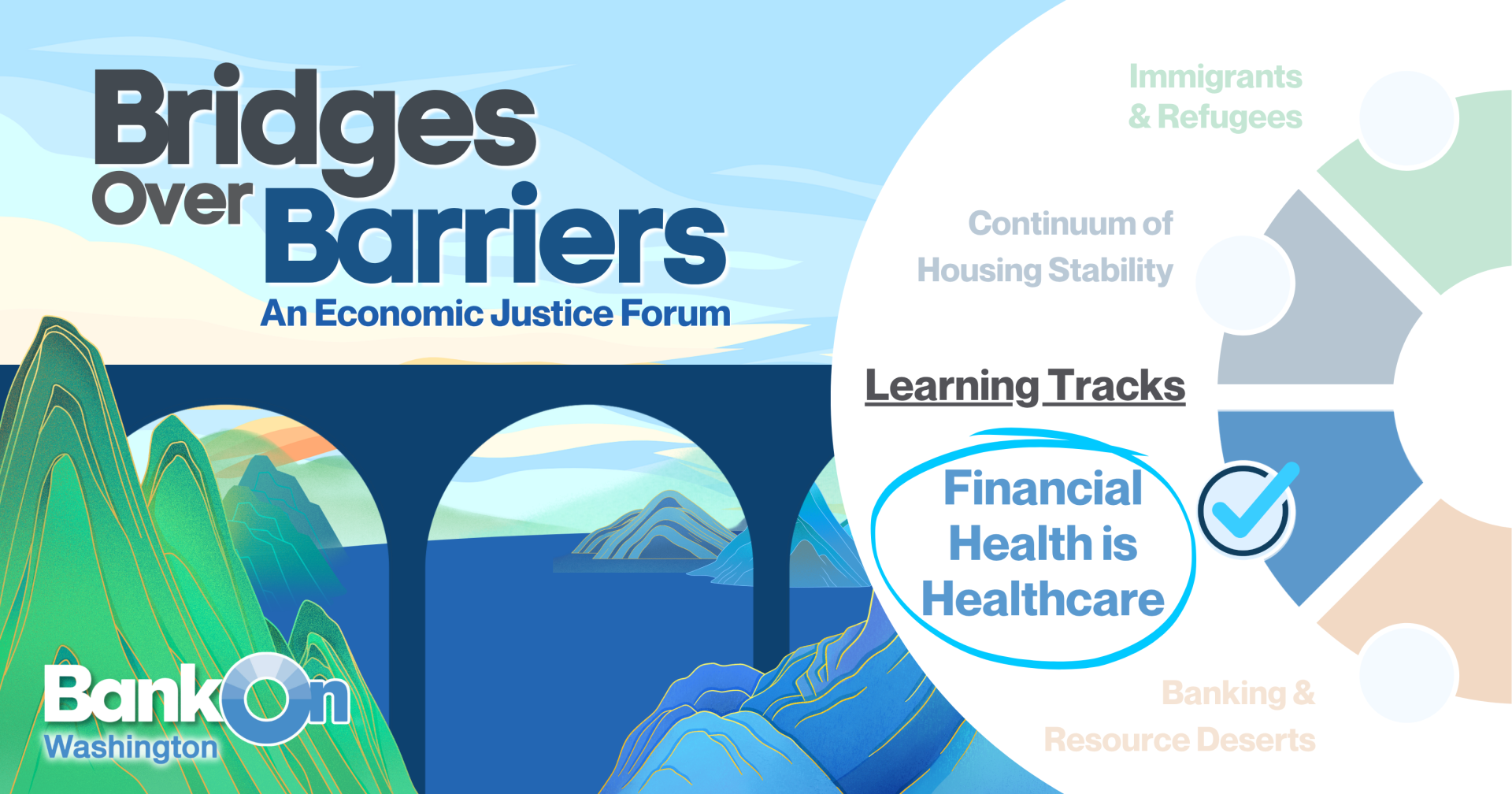
Day 1
Session G: Affordable Health Care for all Washingtonians and Financial Health
12:00-1:00 PM
Lee Che Leong, Northwest Health Law Advocates
US immigration policy perpetuates systemic inequity and racist exclusion, a reality reflected in Washington where the vast majority of individuals without federal immigration status are people of color. Federal policies that largely deny many immigrants access to healthcare mean that many Washingtonians go without critical health care. Being undocumented is the strongest predictor of being uninsured in Washington. In 2019, nearly 1 out of every 4 uninsured adults in Washington lack coverage due to their immigration status. This year federal changes from H.R. 1 continues to strip health coverage access from many lawfully present Washingtonians including refugees and asylees.
Washington is working to mitigate this harm through 2 programs:
1) expanding access to all Washingtonians to HealthPlanFinder, our state insurance marketplace with state subsidies for those up to 250% FPL, and
2) the Apple Health Expansion/Medicaid-like program for adults without access to federal subsidies or federal Medicaid up to 138% FPL
However, current funding for both programs is limited.
Thankfully WA also has programs available regardless of immigration status such as Charity Care at hospitals and Apple Health for Kids.
You're invited to come learn more about current programs, health access options in WA regardless of immigration status, and what you can do to improve access.
Catch this optional “Part 1” with Lee Che:
Upcoming Immigrant Health Changes, Challenges & Options Thursday August 6th, 2026
Workshop Recording | Presentation Slides | Federal Health Care Changes Hub - Northwest Health Law Advocates
Session L: Build a Bridge in Financial Health is Healthcare
2:00-3:00 PM
Moderated by Kitty Grasswell, YWCA
Day 2
Session U: Disability & Financial Health
11:30 AM - 12:30 PM
Ruth Daugherty, NW Access Fund
People with disabilities are far less financially healthy than people who do not have disabilities. They have lower employment rates, lower incomes and less savings, and higher debt burdens and lower credit scores; they are also 3 times more likely to be unbanked. The reasons for these disparities are complex and far-reaching. Financial institutions and financial educators can work to address some of these problems by developing disability competency, understanding disability benefits and the restrictions that come with them, creating thoughtful products that address the needs of disabled people, and providing inclusive financial education.
Session S: Financial Stress Is a Health Issue: How Practitioners Can Respond Without Doing It All
1:30-2:30 PM
Becky House, American Financial Solutions
Abby McCutcheon, American Financial Solutions
Susan Romei, Banner Bank
Fernando Espina, Banner Bank
Liz Seeley, Neighborhood House
Financial challenges don’t stay confined to bank accounts; they show up in stress, health outcomes, workplace performance, and family stability. Practitioners across sectors are often the first to see these impacts, but many are unsure how far their role should extend.
This session explores the connection between financial stress and health and offers practical guidance on how to respond without overextending. Attendees will learn how to identify when a client needs additional support, how to build effective referral pathways, and how cross-sector partnerships can improve outcomes without requiring any one organization to do it all.
Grounded in real-world examples, this session emphasizes a key message: you don’t need to be the expert in everything – you need to know how to connect people to the right support.
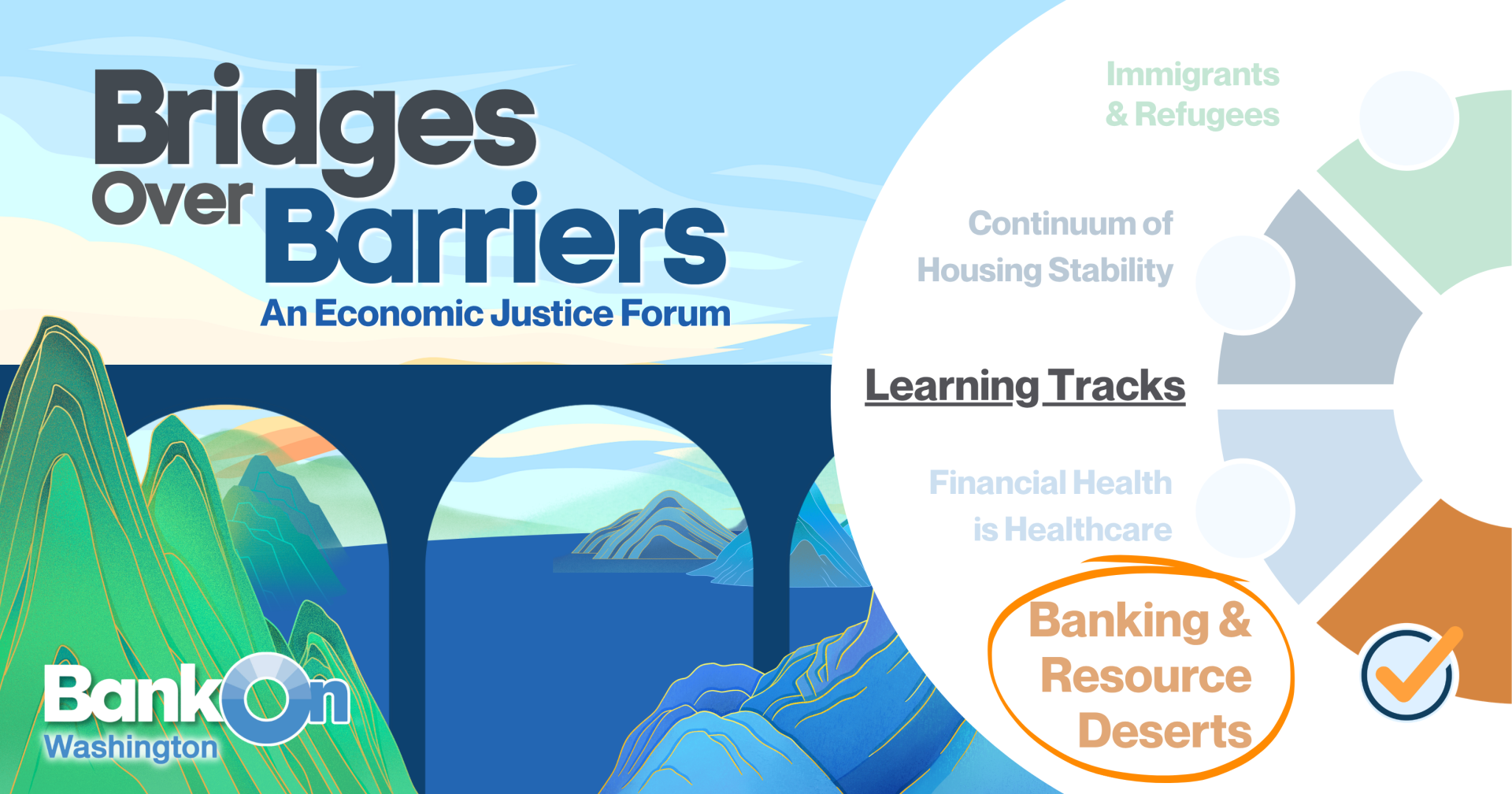
Day 1
Session F: Build a Bridge in Banking & Resource Deserts
10:45-11:45 AM
Molly Morris, Rural Resources
Andrea Alexander, NW Native ABC
This facilitated discussion will bring together ideas and connections for communities with limited access to resources. Both physical distance to available resources and inequitable barriers prevent people from walking their path to financial security.
Together, we will delve into the question: How do we support and protect consumers often driven to riskier and more expensive financial service alternatives because of lack of access?
Session H: Rewriting the Rules of Credit: Advancing Housing Stability Through Equity-Centered Underwriting
12:00-1:00 PM
Maria Sennett, Beneficial State Foundation
Evelin Martinez, Washington Homeownership Resource Center
David Puszczewicz, WSECU
Stable housing is foundational to long-term financial health, yet traditional credit and underwriting models continue to reproduce racial and structural inequities. Built on historically exclusionary assumptions about "risk," these systems often disadvantage borrowers from communities that have been underserved or excluded from mainstream financial institutions, undermining both equity and housing stability.
This session explores how lenders and partners are actively rewriting the rules of credit to expand access to safe, sustainable housing while maintaining safety and soundness. Drawing on lessons from the Underwriting for Racial Justice (URJ) program and applied training in Reimagining Homeownership Services with a Racial Justice Lens, presenters will examine how core underwriting frameworks, such as the Five C's of Credit, can be interrogated, adapted, and reimagined through an equity-centered lens.
Participants will hear directly from Washington-based lenders who have operationalized these shifts, including concrete changes to mortgage product design, underwriting flexibility, and internal policies and change management practices. By pairing conceptual framing with real-world implementation, the session offers actionable strategies for moving from risk aversion to risk management, demonstrating how equity-forward underwriting can strengthen housing outcomes, expand market reach, and remain aligned with regulatory expectations.
Session J: Finding the Oasis in the Financial Deserts
2:00-3:00 PM
Lisa Smith, Washington State Microenterprise Association
Participants will explore and discover the power they have to search and find the information they need to support their dreams.
There are organizations that have been working together for years to break down barriers to opportunity. They have been inspired to change how things are done because they themselves were once in a place where they didn’t know the right person or weren’t living in the right location or didn't know what was out there.
During this session, the presenters will share stories and ideas that will inspire, because over and over when we share information and opportunity, vital change happens for the good. This workshop shines a light on signposts and the pathways to these oases in the desert and then offers simple practical tools to access and use these resources.
Session T: Elevating Tax Benefits Through ITIN Partnerships
11:30 AM - 12:30 PM
Ryan McFerran, United Way of King County
Tasha Dalstra, United Way of King County
Raquel Gomez, Seattle Credit Union
ITIN filers including immigrants and refugees remain significantly underrepresented among users of free tax services outside of King County. Community organizations across Washington operate hundreds of free tax assistance sites each filing season. In 2025, these sites collectively helped file more than 48,000 tax returns statewide. Within King County, United Way prepared 40% of all VITA/TCE returns in Washington last year, and more than 70% of all VITA/TCE returns filed for ITIN holders statewide.
Strong partnerships with local financial institutions, like Seattle Credit Union, have made all the difference. This integrated service model helps reduce key barriers in the ITIN application process, which is often complex, time-consuming, and costly for many low-income households.
Seattle Credit Union's broader impact strategy focuses on serving the most underserved communities across its footprint, with the goal of helping all Washingtonians build generational wealth and long-term financial stability, regardless of immigration status.
This session will briefly address key data security considerations, including IRS data-sharing agreements and coordination with law enforcement agencies, to ensure that expanded service delivery models maintain strong protections for client privacy and trust.
Session Q: Building Financial Safety and Inclusion for Survivors of Gender Based Violence
1:30-2:30 PM
Sabrina Hamm, FreeFrom
Raven Aäe, Haliruna Consulting
Helen Gibson, Express Credit Union
Nuray Ozbay Bilir, Self Help Credit Union
Through multiple surveys of more than 2,000 survivors across the nation, FreeFrom has learned from survivors about their experiences with financial institutions, their current financial needs, and how their financial accounts are impacted by economic abuse. This research confirmed the call to action: survivors need tailored services that address their unique needs. Otherwise, survivors may be locked out of financial services key to navigating daily life and
safety.
In this session, attendees will learn both how gender-based violence and economic abuses can be perpetuated through financial services as well as actions they can implement to support survivors. Elizabeth Escobar (Express Credit Union) and Nuray Ozbay Bilir (Self-Help Credit Union) will provide guidance and examples of how the industry can respond to survivors’ needs. After this session, attendees will understand the role they can play in ending gender-based violence and supporting survivors’ long-term financial security.


